

Forward, backward, and hooks in PyTorch#
A short notebook on what actually happens when you call .backward(), and
how register_forward_hook and register_full_backward_hook let you peek
into the chain rule.
We’ll work with the smallest possible example — a two-layer linear network, no nonlinearity — so the graph has nothing hiding in it.
The forward pass#
When you run model(x), PyTorch does two things at once:
Computes the actual numbers. Each operation (
matmul,add,relu, …) takes tensors in, produces tensors out.Builds a graph. Every tensor that is the output of an operation remembers which operation produced it and what the inputs were. This graph is the record that
.backward()will later walk in reverse.
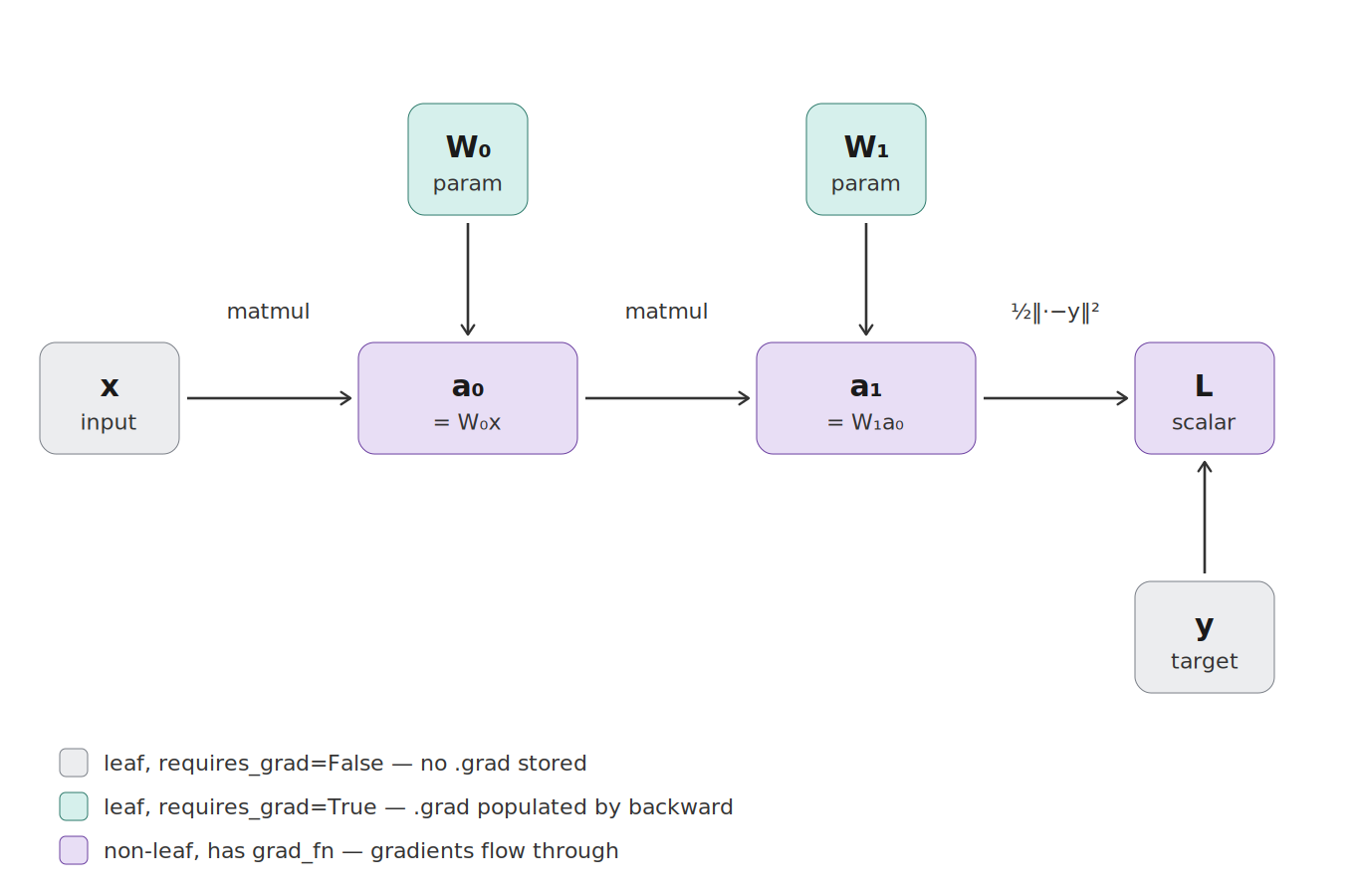
Tensors in that graph fall into three roles:
Leaves with
requires_grad=False(gray in the diagram): the input dataxand targety. They entered the computation; nothing produced them.Leaves with
requires_grad=True(teal): the model parametersW₀, W₁. Also not produced by any operation — they’re the things we want gradients for. After backward, their.gradattribute is populated.Non-leaves (purple):
a₀, a₁, L. Each was produced by an operation and carries agrad_fnpointing back at the op and its inputs. Non-leaves don’t store.gradby default — gradients flow through them during backward but aren’t kept.
The backward pass#
L.backward() walks the graph in reverse from L. At each node it asks:
“for each of my inputs, what was the local derivative of me with respect to
that input?” It multiplies that local derivative into the gradient flowing
in from above (that’s the chain rule) and hands the result off to the input
node, which repeats the process.
Define \(\delta_\ell := \partial L / \partial a_\ell\). Then:
Each step is one Jacobian-vector product with the local Jacobian of that op.
At each linear layer, a second thing happens: the gradient also flows
upward to the weight, producing a weight gradient of the form
\(\delta \otimes (\text{input})\). These upward flows are what populate W.grad:
The reason it’s an outer product: in \(a = Wx\), each weight \(W_{ij}\) appears in exactly one output component \(a_i\), with coefficient \(x_j\). So \(\partial L / \partial W_{ij} = \delta_i \cdot x_j\), which is exactly the \((i, j)\) entry of the outer product \(\delta \otimes x\).
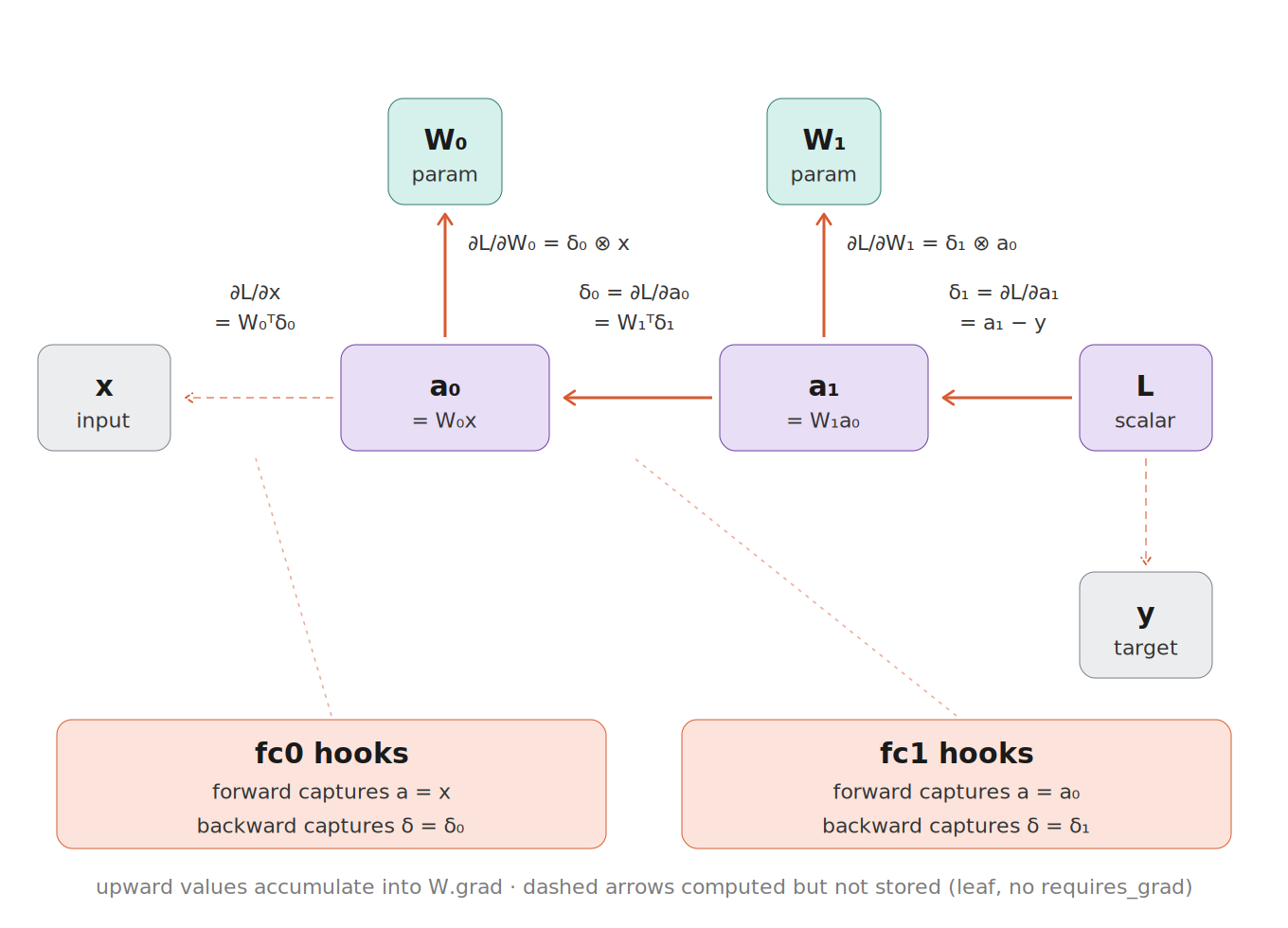
Things to notice in the backward diagram:
The solid coral arrows land on teal boxes. Those are the stored gradients —
W₀.gradandW₁.grad.The dashed coral arrows land on gray boxes. The gradient is computed (PyTorch has to evaluate \(W_0^\top \delta_0\) to propagate through the rest of the graph if there were any) but then thrown away because
xis a leaf withrequires_grad=False.Gradients through the purple intermediate nodes are transient. They flow through
a₀, a₁during backward but nothing stores them. If you wanteda₁.grad, you’d have to calla₁.retain_grad()before.backward().
The nn.Module hook API#
PyTorch gives you three hooks on any nn.Module. Each one lets you run a
callback at a specific point in the forward/backward lifecycle:
Hook |
Registration |
When it fires |
Signature |
|---|---|---|---|
Pre-forward |
|
Before |
|
Forward |
|
After |
|
Backward |
|
During |
|
A few things to note:
Pre-forward hooks are useful for inspecting or transforming inputs before they hit the module. For example, you could clamp activations or log input norms. If the hook returns a modified tuple, that becomes the new input to
forward().Forward hooks see both the input and the output. Returning a value from the hook replaces the output — handy for feature extraction or on-the-fly patching.
Backward hooks see
grad_output(gradients flowing in from downstream) andgrad_input(gradients flowing out to upstream). Returning a modifiedgrad_inputlets you alter gradient propagation.There is an older
module.register_backward_hook()— it is deprecated and will be removed. Always useregister_full_backward_hookinstead; the “full” version handles multi-input/multi-output modules correctly.Every
register_*call returns aRemovableHandle. Callhandle.remove()when you’re done so the hook doesn’t fire on subsequent passes.
For capturing the \((a, \delta)\) factors we care about, we only need two of the three: a forward hook (to grab the input activation \(a\)) and a backward hook (to grab the error signal \(\delta\)). That’s what we use below.
Hooks on our two-layer network#
Let’s see what the forward and backward hooks actually receive for layer
fc₁ in our example.
Forward hook#
For layer fc₁, when model(x) executes, the chain runs
x → a₀ → a₁. At the moment fc₁’s forward finishes, the hook sees:
input[0]=a₀(the tensor that was fed into fc₁)output=a₁(the tensor fc₁ just produced)
Save input[0]. That’s the \(a\) factor — the left-side label on fc₁’s
hook box in the diagram.
Backward hook#
Signature: fn_bwd(module, grad_input, grad_output).
It fires during backward, right after autograd computes gradients for this
module. grad_output is a tuple of gradients flowing into the module’s
outputs; grad_input is a tuple of gradients flowing out to the module’s
inputs.
For fc₁, when backward reaches this layer, the relevant δ is the one at fc₁’s output — which is \(\delta_1 = \partial L / \partial a_1\). So the hook sees:
grad_output[0]= \(\delta_1\) (what we want)grad_input[0]= \(W_1^\top \delta_1\) (the gradient that continues leftward)
Save grad_output[0]. That’s the \(\delta\) factor — the right-side label
on fc₁’s hook box.
Putting the two together#
With (a₀, δ₁) captured from fc₁, you can form the outer product yourself:
which is exactly what ended up in W_1.grad — just recovered layer-by-layer
instead of pre-summed. That’s the hook trick in one line.
Putting it together: hooks on a class-based MLP#
A few details worth noting:
The example uses a ReLU between the two linear layers, matching a more realistic MLP. The math we worked through still applies — ReLU just adds a mask step to the backward pass — and hooks on the linear layers still capture the right \((a, \delta)\) factors for each.
xhas shape(B, T, d_in)— a batch ofBsequences, each of lengthT.nn.Lineartreats any leading dimensions as batch dimensions, so the hooks capture tensors with(B, T, ...)shape. Both the batch and token dimensions are preserved — we haven’t aggregated anything away yet.
import torch
import torch.nn as nn
import torch.nn.functional as F


class MLP(nn.Module):
    def __init__(self, d_in, d_hidden, d_out):
        super().__init__()
        self.fc1 = nn.Linear(d_in, d_hidden, bias=False)
        self.fc2 = nn.Linear(d_hidden, d_out, bias=False)

    def forward(self, x):
        return self.fc2(F.relu(self.fc1(x)))


d_in, d_hidden, d_out = 4, 3, 2
B, T = 5, 6     # batch size, sequence length

torch.manual_seed(0)
x = torch.randn(B, T, d_in).requires_grad_(True)  # requires_grad silences a harmless hook warning
y = torch.randn(B, T, d_out)
model = MLP(d_in, d_hidden, d_out)

captured = {}
hooks = []


def make_fwd_hook(name):
    def fwd_hook(module, inp, out):
        captured[f"{name}_a"] = inp[0].detach().clone()
    return fwd_hook

hooks.append(model.fc1.register_forward_hook(make_fwd_hook("L1")))
hooks.append(model.fc2.register_forward_hook(make_fwd_hook("L2")))

def make_bwd_hook(name):
    def bwd_hook(module, grad_input, grad_output):
        captured[f"{name}_delta"] = grad_output[0].detach().clone()
    return bwd_hook

hooks.append(model.fc1.register_full_backward_hook(make_bwd_hook("L1")))
hooks.append(model.fc2.register_full_backward_hook(make_bwd_hook("L2")))


model.zero_grad()
loss = 0.5 * ((model(x) - y) ** 2).sum()
loss.backward()

for k, v in captured.items():
    print(f"  {k:10s}  shape {tuple(v.shape)}")

print(f"\nBatch (B={B}) and token (T={T}) dimensions are preserved in both hooks.")

# Clean up the hooks so they don't fire on subsequent forward/backward calls
for h in hooks:
    h.remove()
  L1_a        shape (5, 6, 4)
  L2_a        shape (5, 6, 3)
  L2_delta    shape (5, 6, 2)
  L1_delta    shape (5, 6, 3)

Batch (B=5) and token (T=6) dimensions are preserved in both hooks.
Reading the shapes:
L1_ais(B, T, d_in)— the input activation to fc1, with batch and token dims intact.L1_deltais(B, T, d_hidden)— the gradient at fc1’s output.L2_ais(B, T, d_hidden)— the input to fc2, which is ReLU(fc1 output).L2_deltais(B, T, d_out)— the gradient at fc2’s output.
The outer product δ ⊗ a along the last two dims (with a sum over tokens)
reconstructs the per-sequence weight gradient. Without summing over tokens,
you have per-token factors — useful for packed-sequence work. Without
summing over batch either, you have the full per-sample, per-token picture.
The hooks capture everything; you choose what to aggregate and when.
Sanity check: does the reconstruction match W.grad?#
Summing the outer product over both batch and token dimensions should recover the stored weight gradient exactly.
# Reconstruct fc2's weight gradient from the captured factors
# L2_delta: (B, T, d_out), L2_a: (B, T, d_hidden)
# Outer product per-token, then sum over B and T
g2_reconstructed = torch.einsum("bto,bti->oi", captured["L2_delta"], captured["L2_a"])
g1_reconstructed = torch.einsum("bth,bti->hi", captured["L1_delta"], captured["L1_a"])

print("fc1.weight.grad matches hook reconstruction:",
      torch.allclose(g1_reconstructed, model.fc1.weight.grad, atol=1e-6))
print("fc2.weight.grad matches hook reconstruction:",
      torch.allclose(g2_reconstructed, model.fc2.weight.grad, atol=1e-6))
fc1.weight.grad matches hook reconstruction: True
fc2.weight.grad matches hook reconstruction: True
Both match. The hook capture is the gradient in factored form — you just
choose which dimensions to sum out when you want the stored .grad back.
Why Kronecker products show up#
When PyTorch computes the weight gradient at a linear layer, it does this:
where \(A\) (shape B × d_in) and \(\Delta\) (shape B × d_out) are the stacked
per-sample activations and errors — exactly what our hooks captured. That
matmul is a sum of outer products \(\sum_t \delta_t a_t^\top\), but PyTorch
never forms the individual outer products. It goes straight from the two
factor tensors to the summed matrix in one GEMM.
The Kronecker product is just the vectorized version of the same structure. For a single sample, if you flatten the weight gradient matrix \(\delta a^\top\) column-by-column into a vector, you get:
Concretely with \(\delta = [1, 2]\) and \(a = [3, 4, 5]\):
The payoff is storage. For \(d_\text{in} = d_\text{out} = 4096\), the flattened
gradient is \(1.7 \times 10^7\) numbers — but it’s fully determined by the two
factors \((a, \delta)\), which are \(8192\) numbers total. The hooks expose
exactly these factors, before PyTorch’s final matmul fuses them into
W.grad.